
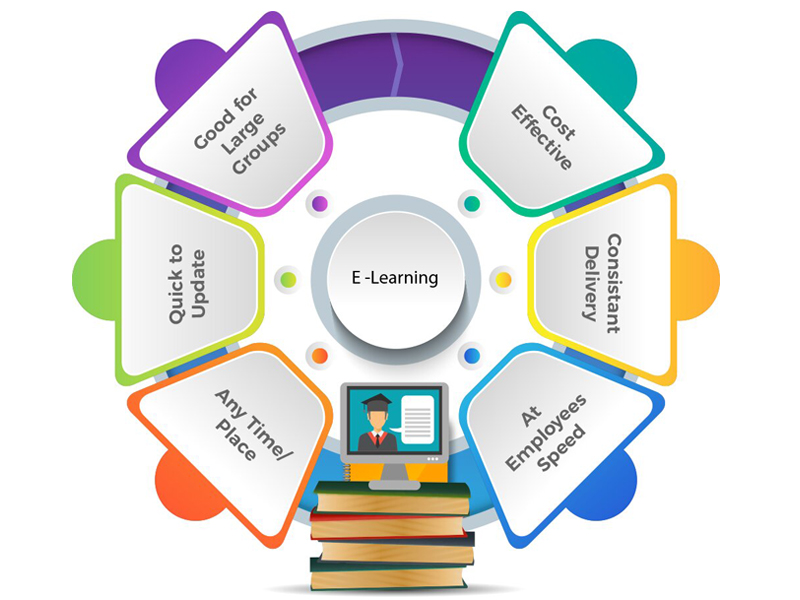

E-Learning Education Model

ABSTRACT
E-learning is a means of education that incorporates self-motivation, communication, efficiency, and technology. Due to the fact that there is limited social interaction, students must keep themselves motivated. The isolation intrinsic to e-learning requires students to communicate with the instructor frequently to accomplish their assigned tasks. E-learning is efficient as it eliminates distances and subsequent commutes. Distance is eliminated because the e-learning content is designed with media that can be accessed from properly equipped computer terminals.
With its unique features e-learning is an experience that leads to comprehension and mastery of new skills and knowledge, just like its traditional counterpart. The paper discusses the types of e-learning, the advantages and disadvantages, instructional strategies for e-learning, delivery methods and assessment of e-learning.
Key Words: Means of Communications, Learning Class Structure, Forms of Technologies, Management Education, Assessment.
REFERENCES
Asynchronous Learning: http://en.wikipedia.org/wiki/Asynchronous_learning
Blacboard: http://www.prenhall.com/dabbagh/ollresources/self-directed-strategy-frameset.html
Clark, Anne & Pitt, Tina. (2001). Creating powerful online courses using multiple instructional strategies. From http://www.emoderators.com/moderators/pitt.html
Gardiner, L.F. (1994). Redesigning higher education: Producing dramatic gains in student learning. Washington, DC: Association for the study of Higher Education.
E-Learning: http://en.wikipedia.org/wiki/E-Learning
Floretta Ekwensi, an Instructional Designer from Georgia, is working towards her Master's of Science degree in Instructional Technology (MSIT) from Bloomsburg University as a distance education student.
Instructional strategies for online courses. (2006). Illinois Online Network. From http://www.ion.uillinois.edu/resources/tutorials/pedagogy/instructionalstrategies.asp
Kirkpatrick, D.L. (1996). Evaluating training programs: The four levels. San Franscisco: Berett-Koehler.
Loughney, M. and DelVecchio K. Key Benefits of ELearning: http://www.exomedia.ca/eLearning/benefits.cfm
Matthew, Norman & Dohery-Poirier, Maryanne. (2000,) Using the World World Web to enhance classroom instruction. From http://firstmonday.org/issues/issue5_3/mathew/
MacLean, D.D. (1996). Use of computer-based technology in health, physical education, recreation and dance. ERIC Digest 94-7, Washington, DC: ERIC Clearinghouse on Teaching and Teacher Education. ED 390 874
Matthew is an Instructional Technology graduate student at Bloomsburg University of Pennsylvania.
Parrat, S. (1995). Future Learning: Distance education in community colleges. ERC Digest 95-2. Los Angeles, CA: ERIC Clearinghouse on Community Colleges, ED 385 311
Pulichino, Joe. (2004,) The Learning Guild: Report on trends in organizational practices of synchronous e-learning. From http://www.webex.com/pdf/elearning-guild.pdf
Rintala, J. (1998). Computer technology in higher education: An experiment, not a solution. Quest, 50(4), 366-378, EJ 576 392
Ryan, M., & Hall, L. (2001). E-learning, teaching and training: A first look at principles, issues, and implications. (Report No. AACE-ED-466-209). Charlottesville, VA: Association in Advancement in Computer Education.
St.Pierre, P. (1998). Distance Learning in physical education teacher education. Quest 50(4). 344-356. EJ 675-391.
Self-directed-learning: Supports with each product (2002,) Pearson Education Inc. From http://www.prenhall.com/dabbagh/ollresources/self-directed-strategy-frameset.html
Strain, J. (1987). The role of the faculty member in distance education. American Journal of Distance Education, 1 (2).
Strain, J. (1987). The role of the faculty member in distance education. American Journal of Distance Education, 1 (2).
Ten Strategies for a successful eLearning experience. Online Degree Search. From http://www.online-degree-search.net/strategies.html
Tham, C.M. & Werner, J.M. (2005). Designing and Evaluating E-Learning in Higher Education: A Review and Recommendations. Journal of Leadership and Organizational Studies, Vol. 11, No.2
Webster, J., & Hackley, P. (1997). Teaching effectiveness in technology-mediated distance learning. Academy of Management Journal, 40(6): 1282-1309.
World Wide Learn. E-Learning Essentials: Delivery Methods: www.worldwidelearn